Normally, from where I live in Los Angeles, it’s about an hour and a half to UCLA, where I was going to have my surgery. At 5 a.m. that drive was cut down to 22 minutes.
I asked my husband to let me drive his car there with him as a passenger. I’m an anxious passenger, and I wanted to be in full control of the morning and the entire hospital stay. This was a way to set that tone — I’m in the driver’s seat.
We arrived at UCLA Medical Center just before 5 a.m. and we immediately ran into our first issue — parking.
Parking has been the bane of my existence through a lot of these appointments; either it’s $37.95 a minute or non-existent.
I’d been to the medical center several times at this point, but never at “night” and never to the hospital portion of the campus.
As we arrived, there were absolutely no directions where to go, where to park, where to walk in for admissions, anything.
We found an empty valet stand, but we didn’t want to valet anyway. My husband wasn’t staying overnight, and there were some nice-to-have supplies like my favorite pillow in the trunk — just in case.
I circled the campus again and saw Garage 7, Garage 8, Public Parking Garage 9 — yet every entrance I went to was restricted access — card holders only.
It’s getting closer to my 5 a.m. check in time, and I’m getting nervous that I won’t find parking. My husband did the right thing (despite me hating it) and said to get in the passenger seat; he’ll drop me off at the entrance and go figure it out from there.
I walked into a grand hallway, seemingly recently refurbished. Marble and stone everywhere, but not a sign or directions to be found — great.
I wandered and saw a sign for Admissions to the right. I started walking to the right and realized it’s the end of the hallway with only locked doors.
A faint voice said, “Can I help you, sir?” I preferred “Young Man” from my first urologist, but OK — whatever.
Hiding behind a slab of rock is a security guard waiting to get off their shift in a few minutes. They flick their hand towards the same Admissions sign I’d seen 17 seconds earlier but with a little “it’s hiding in there” — what?
Oh, the sign that says go to the right should actually be saying “you’re here, come behind this wall to a hidden door for no reason”.
After months and months through various health systems, I was getting used to filling out the exact same forms 100 times. My first oncology appointment was a defining moment of frustration, but it’d gotten so routine by now I didn’t care.
For the first time in history, all those forms actually were saved in their system. Two simple signatures and I was done — head over to the waiting room for family and they find you and will bring you up to your floor.
When I walk into Maddie’s Room, it’s lit as my husband said. So many families and groups of people, not one or two sitting alone. Groups of 10 talking and chatting. All somber, but somber together. They were there not only to support their loved one about to go into surgery, but also support the others around them.
I’ve never had someone close to me with a type of cancer that requires serious treatment. I’d never sat in a hospital room wondering if a family member or friend was going to wake up from anesthesia.
My time there was quick and there was a woman yelling RICHAARRRDDDD. I always go by Rick and I know I’ve done something wrong when Richard gets brought out.
Here’s a form, here’s a bracelet, take it to the 3rd floor and go check in.
I head up and see there’s a line of around 10 people waiting to check in — oh great, I got here at 5 a.m. and now I’m going to have to sit around forever.
Well, that wasn’t the case — within a few minutes I’m being handed special sanitation wipes for my body and “anti-colonization” swabs for my nose.
Pretty straightforward things to do, but I realized very quickly that I’ve been shoved things, shoved towards a gurney with a curtain, and this was about to get very real very quickly.
My husband had to help me wipe my back, and then I re-read the instructions for the nose swab 8x. At the end of the day, not complicated, but I couldn’t imagine doing it by myself in that moment.
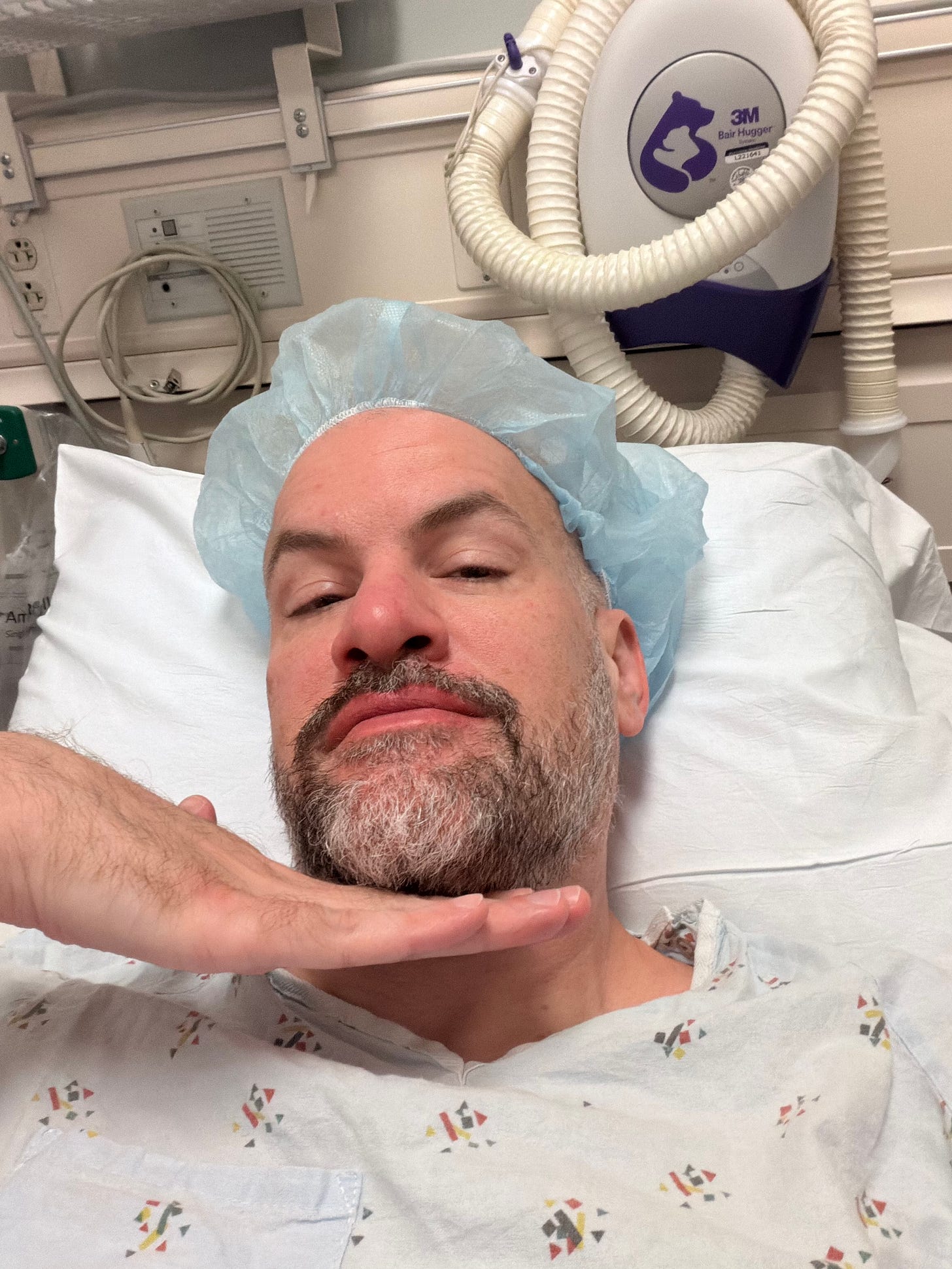
I threw on a gown and a lunch lady hair cap and sat down on the bed.
I looked at my husband, realizing that I’m going to have to depend on him for things over the next week, so I better be sweet — but also, this is something he’s going through too, and I want a final check-in for the “team”.
We hadn’t exactly had the smoothest ride leading up to surgery. We have wildly different ways of researching things and what type of information makes us feel grounded and sure.
Partway through the journey, we realized we had different preferred treatment options, and neither of us could completely understand how each got there.
All options on the table make choosing one for yourself very hard. Add a 3rd party to that, and you just have questions and doubts that seep in everywhere.
At some point along the ride, I had explained to him that my decision was more mental than anything, and my anxiety couldn’t deal with “leaving it in there” — despite many doctors telling me that’s not the best way to look at it.
He wanted the “easy” options with the least side effects. We actually romanticized the thoughts of a specific radiation treatment facility near San Diego near the ocean that would require us to move down there for a month. It turns the whole thing into a dream almost that you can forget afterwards — something both my husband and I did agree on.
But when I was able to articulate my personal mental health concerns about the anxiety, he was fully onboard.
Now, many months later on that gurney, I couldn’t have felt like I had someone supporting me and my choices more. I was previously worried that if we disagreed and I ended up on this gurney, I would see the doubt in his eyes and fear that he thought I was an idiot.
I’m looking at the “room” around me. I’m looking at my husband. The used antibacterial pads — where do they go? He takes them from me and just sets it down on the bed — he realizes it doesn’t matter — but I’m not there yet.
My anesthesiologist was the first person from the Prostate Pit Crew that came to speak with me. She was very nice, seemed smart, all of the things that should be reassuring. She laid out her plan. She noted on my chart that I have a certain gene mutation that makes my body hyper-metabolize things like pain killers so that she’d be monitoring my sedation closely. She re-asked all the same questions — no, I don’t have congestion — no, neither me nor my family members have had an adverse reaction to anesthesia that I know of.
I will say I’ve finally reached the age where everyone looks too young. She was a brilliant doctor, and I just saw “20 something” in her face.
Either way, she points towards the IV catheter on my hand and says we’ll give you a little something to relax you before we get back to the OR — great.
I honestly felt great in this moment, and my anxiety was relatively at bay. Despite this being the most terrifying thing I had ever walked into, I felt ready.
I’d done my research, I’d picked the best hospital system and doctor, I’d done my due diligence. Not only was I ready with information, but by this point, I’d trimmed off nearly 70 lbs. and gone from wholly inactive and sitting in front of a computer to being a gym rat on the elliptical 6 or 7 days a week and working with a trainer 2-3x on strength as well.
The months leading up to surgery, I practically lived in the gym, and for the first time in my life, I loved it. I felt like I was doing everything I could to make this surgery a success.
My doctor had given me as much time as I wanted to handle things, and I used that time to its fullest.
I’m from Middle Georgia and grew up on country music. Tim McGraw is “one of the good ones” (as of me typing this) and was only behind a few of the greats that I loved their music as much.
He has such a good catalog of music, but most people are familiar with Live Like You Were Dying.
I was in my early 40s,
With a lot of life before me,
When a moment came that stopped me on a dime.
Over the last few months before surgery, I lived like I was dying. To be clear, I never felt like this was a death sentence — for most, it’s not — but I definitely didn’t want to feel like I wasted my time or wallowed in my feelings. I wanted to actually feel something. So I did.
I went skydiving from 18,000 feet.
I went on a solo road trip to see the most stars I’ve ever seen.
I saw my mom right after she was diagnosed with dementia.
I met my best friend’s new baby (that’s my nephew, don’t say it ain’t — love you, Logan).
I started learning how to code iPhone apps.
I wrote an outline for a screenplay.
I did some fun drugs and some really fun drugs.
I saw friends for who they really are — and who they really aren’t.
I forgave mistakes big and small, even if the offenders don’t know they’re forgiven.
You can call it a distraction, which it definitely was, but it felt like what I wanted to do.
The Friday before surgery, I wanted to complete my Tim McGraw trifecta and ride a bull — mechanical at least. It wasn’t the first time for me in real or mechanical, but it’d been a long while and many sessions of physical therapy on my knees since then.
But — I’ve been getting so healthy — I’ve totally got this — and I did. It was a fun short ride. Probably not worth the 1:15 drive to Saddle Ranch Chop House, but I was surrounded by some of my dearest friends, eating fatty tourist trap food, getting thrown off a bull.
Two days off from surgery, and I’d completed my “bucket list”.
We try and go to another bar after dinner, but my heart really isn’t in it — we’ve done the fun stuff, now let’s get serious.
I spent the weekend before surgery getting our guest room ready with incontinence pads, laxatives, enough water to start a desert oasis. I’ve got Ensure, I’ve got Jell-O, I’ve got Apple Sauce — what else do I need?
I knew I’d be tossing and turning and wouldn’t be sleeping much, and the last thing I wanted to do was to make my sweet husband go through that too.
I’d been piling supplies up for months, cross-checking Reddit, UCLA, the Mayo Clinic, Substack. If someone gave me a list of things I need, I bought it. I had a pulse oximeter despite my always-worn Apple Watch having one built in. To say it was excessive was an understatement — but it made me feel prepared.
So as I’m sitting on this gurney watching as the anesthesiologist puts something to calm me in my veins, I almost said, “I’m fine actually — but when in Rome, get that injection.”
I say goodbye to my husband, and I can see the fear and anxiety in his face. I take a deep breath, and the nurses start pushing.
Continue reading — Part 2: The Toughest Night →